back to companies
 Product
 Finland
FLYINGVISION SAS
FLYINGVISION designs and manufactures robotic and mechanical products dedicated to non-destructive inspection and more generally to every field of the industry.
ProductFinland Loading…ProductFinland
FLYINGVISION designs and manufactures robotic and mechanical products dedicated to non-destructive inspection and more generally to every field of the industry.

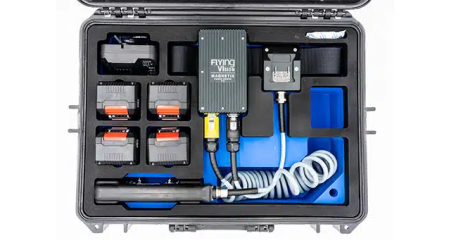
For all your metal inspections, choose the MAGNETIX 2.0 portable magnetic particle inspection pack, the complete NDT control solution by magnetic particle testing (MT, or Magnetic Particle Testing in English).
Designed for optimal use in field conditions, this video recorder pack combines compactness, lightness and an ultra-ergonomic design. Its power management system, managed by a microcontroller, offers unrivalled reliability and performance in the sector.
The MAGNETIX Power Pack 2.0 portable magnetic particle inspection pack is designed for non-destructive testing (NDT) professionals who need a portable solution for magnetic particle inspection (MT NDT) in the field. Thanks to its robust and compact design, this system is ideal for use in harsh and varied environments.
Introduction
Magnetoscopy is a non-destructive testing technique (NDT MT) which makes it possible to detect imperfections on the surface or sub-surface of ferromagnetic materials, such as iron or cast iron. This method of NDT monitoring is fast, efficient, and can be performed using a variety of equipment, including portable and mobile magnetic particle scanning systems.
Principle of Operation
The heart of the magnetic particle inspection method consists of inducing a magnetic field in the part being examined. This field can be created by different means, such as the battery-powered electromagnet or the magnetoscopy clamp. Discontinuities in the material disrupt this field and attract magnetic particles from a colored or fluorescent indicator product to form visual indications.
Indications
Indications are generally made visible using liquids containing magnetic particles, which can be colored or fluorescent.
Applications
Magnetoscopy is regularly used for NDT MT control of ferromagnetic materials in several sectors:
Benefits
Conclusion
The NDT control method by magnetic particle inspection is a global control technique, quick and easy to implement. It is widely applied in various industrial sectors to ensure the quality and safety of metal structures. Magnetic particle scanning packs are often available to facilitate the application of this essential technique.
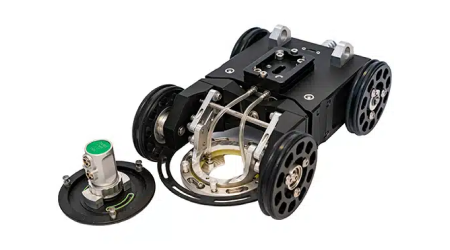
The RUC1 is an ultrasonic B-scan Runner specially developed to meet the challenges posed by inspections of elements at heights of less than 10 meters, which usually require expensive means or involve significant risks for personnel. Designed to be deployed by pole or manually, its innovative design allows quick, precise and ergonomic controls for reliable and secure results.
The RUC1 provides an innovative solution for performing ultrasonic inspections on structures in heights less than 10 meters in areas such as petrochemicals, energy, shipbuilding and heavy industry. By being deployable by pole, this ultrasonic Runner B-scan avoids the high costs and dangers associated with conventional methods. It is particularly suitable for controlling equipment such as tanks, tanks, vertical pipes, small storage bins, boat hulls and many other similar structures. It can also be used manually thanks to an ergonomic handle to easily carry out your US B-scan checks at eye level. The addition of magnetic wheels greatly increases the stability of the Runner and allows it to be left in position without holding it when used manually on ferromagnetic surfaces.
Performance
Quality
Security
Versatility
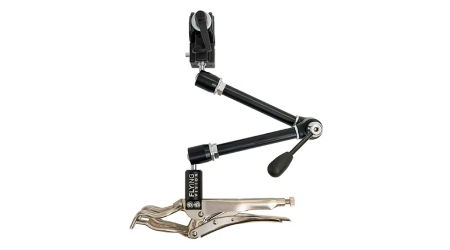
The OPG is the essential tool for your gamma graph. An innovative instrument, this gamma clamp is specifically designed to optimize the positioning of the radioactive source or the collimator during checks by industrial radiography or industrial gammagraphy in the demanding field of Non-Destructive Testing (RT).
This positioning accessory or collimator support, essential to gammagraphy, ensures the immobility and precise positioning of the source, thus allowing exact localization and repeatable control results. The operational efficiencies offered by OPG during a radio shot translate into saving time and money for businesses while maintaining the integrity and accuracy of inspections.
The robust and functional design of our gammagraphy pliers makes the OPG an essential ally for all NDT professionals wishing to increase the productivity and reliability of their industrial gammagraphy operations.
In the demanding field of Non-Destructive Testing (NDT RT) by industrial radiography and industrial gammagraphy, the accuracy and stability of the positioning of the radioactive source are crucial to ensure the quality and reliability of inspections. Gamma clamps or ellipse clamps serving mainly as collimator supports are essential tools to guarantee the precision of the controls, the immobility of the source and precise localization.
These specialized tools are essential in sectors such as the petrochemical industry, shipbuilding, power generation and aerospace, where every detail counts. They offer operators the ability to quickly and accurately position the source, resulting in significant time and cost savings for businesses. The repeatability of the control, ensured by the use of these gammagraphy accessories, also contributes to the optimization of inspection processes, thus strengthening confidence in the safety and quality of the inspected structures and components.
Introduction
Industrial Radiography Testing (RT) is a Non-Destructive Testing (NDT) method that uses ionizing radiation to examine the internal integrity and structure of materials. This technique is widely used in industries such as aerospace, petroleum, construction, and metal fabrication to detect defects such as cracks, inclusions, porosities, and other anomalies that cannot be seen on the surface.
Principle and importance of accessories
Employing ionizing radiation from sources such as iridium-192 or selenium-75, this method creates X-ray images that reveal the internal structure of materials. Source positioning accessories such as gamma clamps or ellipse clamps are crucial for precisely placing the radioactive source and obtaining clear, detailed images.
Sample Preparation:
Source Positioning:
Exposure:
Interpretation:
Conclusion
In short, the use of specific accessories, including our gamma positioning tool and compliance with current standards are key elements in the success of industrial radiography inspections, thus contributing to safety and quality in the industry.

The RICI is a remotely piloted robot designed to carry out non-destructive control inspections (UT, PA, or other) on submerged vertical or horizontal walls, flat or with low curvature, including in radioactive environments. Thanks to its precision, versatility, innovative suction system, and numerous options, it allows you to carry out your tank inspections with unequalled efficiency and precision.
Our underwater inspection platform, RICI, is a robotic NDT control solution for submerged walls, initially developed for applications in nuclear environments where radiation tolerance issues are present.
The initial problem was to develop a robotic CND carrier capable of controlling in Phased Array PA the welds on the walls of a mechanically welded stainless steel tank 10 meters deep in a nuclear environment with high radioactivity.
To meet this need, we have created a modular robotic platform capable of deploying different NDT techniques, adapting to the surfaces to be controlled and operating in difficult submerged environments.
Deployable means of control:
The architecture of our underwater wall inspection robot allows you to adapt any type of NDT technique (PA, UT, CF, etc.) and probes to this means of control. The robotic platform is independent of the control means itself. Our underwater inspection robot is therefore a tool for deploying NDT resources. Its main functions are its movement on 2 axes with the precision of the order of a millimetre, video feedback, optional laser sight and video recording with positioning data via OSD.
Controllable elements
In its original configuration, our submerged tank NDT inspection robot is capable of moving on flat sheets with moderate flatness defects up to a depth of 20 meters. It can also move on concave or convex surfaces with large radii of curvature. Please do not hesitate to contact us for more information regarding inspections on concave or convex surfaces.
Control environment
We guarantee the operation of our CND robotic platform, RICI, at a pressure of 2 bars (20 meters). Do not hesitate to contact us for monitoring needs at greater depths. To tolerate operation under significant ionizing radiation, we have integrated all the sensitive components of our underwater CND robot into the ground station. The camera remains the only component interacting with a radioactive environment. To delay interference to the video sensor as much as possible, the camera housing is designed to offer biological protection against radiation (leaded glass, thick walls of the housing). This biological protection only delays parasitism, thus saving precious meters of control.
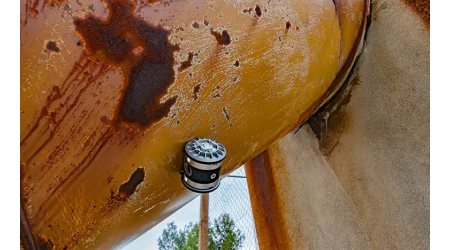
Enter a new era of inspection and visual exploration with the VIR-1, an avant-garde magnetic robot, which thanks to its innovative technology and geometry, allows access to the most inaccessible areas of the naval, petrochemical industry and much more, combining compactness, autonomy and movement on ferromagnetic surfaces.
The VIR-1 is a mini radio-operated robot designed specifically for visual inspections and exploration in difficult-to-access industrial environments. Thanks to its innovative technology, wireless control system and HD video feedback, our VT inspection robot is capable of moving on vertical ferromagnetic metal walls, allowing visual checks and the discovery of previously inaccessible areas. Among the areas of application, we find:
The VIR-1 visual inspection robot offers great versatility thanks to its extreme compactness and wireless autonomy, allowing it to perform visual inspections and explore environments previously impossible to reach.
Performance
Quality
Security
Versatility