back to companies
 Product, Service
 Argentina
LMATS Pty Ltd
LMATS provides advanced testing and inspection services in Melbourne Victoria, Sydney - NSW and Brisbane Queensland, Tasmania, and South Australia.
Product, ServiceArgentina Loading…Product, ServiceArgentina
With the help of industry support and collective efforts of technical specialists, LMATS Pty Ltd was established in Melbourne, Victoria in July 2008. LMATS is an abbreviation for Laboratory for Materials Analysis & Testing Services.
The founder of LMATS Mr. Pranay Wadyalkar confirms that LMATS is established solely to assist various industries by understanding their requirements and to provide effective and quality services.
LMATS has been extensively and rapidly accepted in the industry as a reliable testing and inspection services provider because several customers recommend other companies to utilize LMATS services. Concurrently, LMATS consistently delivered quality services to exceed customer’s satisfaction. As a result, LMATS had a rapid growth Australiawide and currently LMATS is providing services from
Victoria – Melbourne (Williamstown and Dandenong),
New South Wales - Silverwater (Sydney) and Wodonga/Albury,
Brisbane (Archerfield, Queensland) and Perth (Canning Vale, Western Australia)
LMATS team comprises of a mix of experienced and young professionals, with a combined 200 years relevant industry experience across all industries.
LMATS provides comprehensive testing services in the fields of but not limited to Advanced NDT, Conventional Non Destructive Testing (NDT), Hydrostatic testing, Pressure equipment / Structures Inspections, engineering and mechanical testing, chemical Analysis and Positive Material Identification, Corrosion Resistance Testing, Weld testing and WPS Qualifications, Metallurgical Services and Material Identification, Protective Coatings testing, Professional Services – Quality Assurance, NDT Level 3 services, Ceramics / Refractory/ Abrasive test and Calibration Services

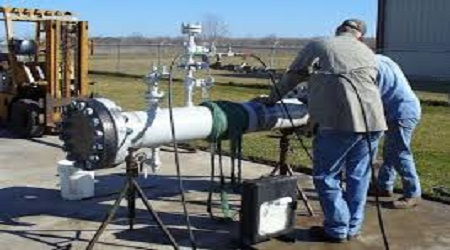
A hydrostatic test is performed to determine the integrity and soundness of pressure vessels and piping joints. A decrease in the applied pressure or leakage through the products or joints or plastic deformation or distortion or bulging in the product is indication of inadequate quality of the product under test.
This test method is also termed as Leak testing (based on the principles of leakage during pressurised condition) and Pressure Drop Test (based on the principles of decrease in pressure during test due to unacceptable discontinuities). It is also the most common method often employed and it is the one of the most reliable test methods when determining the integrity and soundness of the vessel. Some of the standards permits hydrostatic test as a substitute for other expensive non-destructive test methods.
This test is preferred over pneumatic test due to safety reasons. Hydrostatic test method is applied on the newly manufactured pressure equipments, after alterations, repairs and before recommissioning stage.
LMATS holds proven test procedures and NATA accreditation for testing of pressure vessels, pressure piping, cylinders, pipes, hoses, valves, fittings and other pressure components. LMATS performs hydrostatic test in accordance with AS 4037, AS 4458, AS 4041, AS 1210, AS 1228, AS 2885.2, AS 1579, AS 1631, ASME V Article 10 and similar national/international standards.
LMATS offers hydro pressure tests through its Melbourne and Sydney testing laboratories.
The LMATS Purpose built Hydrostatic test unit has electronic recording for fast operation.
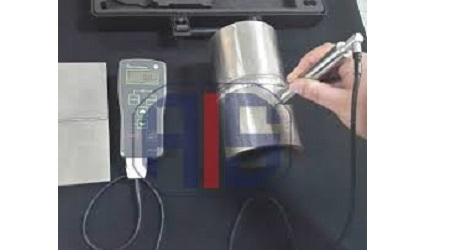
Non destructive testing (NDT) is an engineering practice where material characteristics – some of the physical and chemical properties, product condition, size, shape and discontinuities can be detected, examined and evaluated without destroying or damaging the product. These tests are performed in a manner that does not affect the future usefulness of the object or material.
NDT is commonly used as a quality assurance practice for ensuring products compliance for welds, castings, forgings and other wrought products.
NDT is widely used as one of the condition monitoring practices for plant and assets life assessment, reliability engineering, maintenance. Most of the NDT methods are reliable, accurate and economical.
LMATS provide various types of non destructive testing services to suit client’s requirements. Please navigate through the adjacent panel or enter your keyword in the search box to obtain additional information relevant to your requirements.
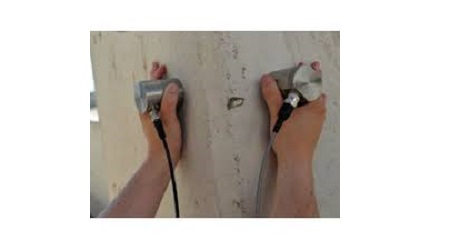
Tests on Concrete & Refractory material
Several types of tests are performed on concrete and refractory materials to determine physical, engineering and chemical properties. LMATS has experienced staff that can perform and advise adequate tests to determine suitability or reliability of the existing or new concrete, ceramic or refractory products.
Visual inspection is the most common and significant test on concrete structures to determine engineering and aesthetic condition. Visual inspection can detect unacceptable flaws related to workmanship, structural serviceability and material deterioration. Some of the flaws are cracks, pop-outs, spalling, disintegration, colour change, weathering, staining, surface blemishes and lack of uniformity.
Radiographic examination is one of the conventional test methods performed on concrete structures. The intensity of radiation beam (ionising radiation) decreases (attenuation) while passing through a material. The amount of radiation attenuation depends on the quality of radiation, the density of the material and the thickness traversed. A radiograph is exposed to the attenuated radiation beam and the change in density on the radiograph is used to determine concrete condition, density, porosity, cracks, reinforcing bars and its condition (location, spacing, depth, dimensions, corrosion etc).
Ultrasonic test is conventional and contemporary test method on concrete structures. An electro-acoustic material is held in contact with the test surface and a pulse of longitudinal vibration wave is transmitted into the test material. The applied vibrations reflect (echo) from the interface between matter of different acoustic impedance property and return to the transducer. The amplitude of the reflected signal and the time taken to return to the transducer can reveal information such as strength, density, concrete thickness, cracks, laminations, reinforcing bars and its condition (location, spacing, depth, dimensions, etc)
Infrared thermography is one of the non-destructive test methods on concrete structures. The change in surface temperature (0.3degrees Celsius change) is recorded (thermogram) to determine the temperature distribution at the test surface. The change in temperature can reveal information such as leakages, cracks, laminations, reinforcing material.
Electromagnetic methods for concrete testing utilize eddy current effects. Currents in a search coil set up and eddy currents in the reinforcement material cause to change impedance in the search coil. This change in electrical impedance reveals various properties such as location and depth of reinforcing materials, etc.
Navigate through the adjacent panel or enter your keyword in the search box to obtain additional information relevant to your requirements or talk to one of the LMATS staff to complete your requested task.
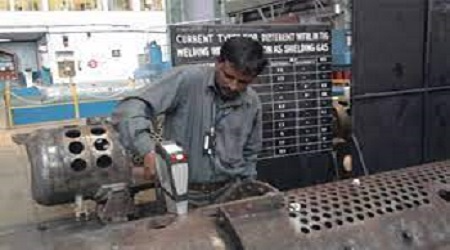
Positive Material Identification, commonly known as PMI can be performed using several test methods. LMATS employs a simple non-destructive test method called as XRF (X-Ray Fluorescence Spectroscopy) by using Thermofisher Niton XLT 818 or Innov-X Alpha and OXFORD Instruments X-MET 7500 analysers. These instruments are widely accepted by various industries and especially the petrochemical industry where the precision test results are paramount.
LMATS is NATA accredited for testing several grades of materials.
Note - The portable XRF method used to determine the chemical composition of the material is valid for the identification of the principal alloying elements only. In most cases this provides sufficient data to enable a reasonably reliable estimate of the material type. This method cannot detect carbon and hence the sole analysis should not be used to select materials for applications where the material’s strength is critical. For detailed steel material identification, either a full chemical analysis should be performed or supplementary mechanical tests should be performed.
LMATS has recently been expanded PMI testing to include :
Sydney
6.94 Comparative indication of material grade and alloy type
.01 Comparative indication using portable XRF equipment
UNS# A13840, A90583, A96063, C36000, C62700, C83600, R30605, R30816, S30300, S30400, S31254, S31600, S31700, S32100, S32750, S43100, SAE G4130, G4140, AISI 4340, 17- 4PH, CDA 386, CDA 360, Inconel 901, AISI 8620, AISI 1045, Hastalloy X, H13 toolsteel, Duplex 2205, Duplex 255, Super Austenitic 254
see NATA website
Melbourne
6.94 Comparative indication of material grade and alloy type
.01 Comparative indication using portable XRF equipment
UNS# A13840, A90583, A96063, C36000, C62700, G43400, C83600, G86200, N06002, N09901, R30605, R30816, S17400, S30300, S30400, S31254, S31600, S31700, S32100, S32205, S32550, S32750, S43100, T 20813
SAE# G4130, G4140, G5200
see NATA website
LMATS also deploy Spark Atomic Emission Spectroscopy technology. Contact LMATS Melbourne or Sydney testing laboratories for your PMI or material identification requirements.
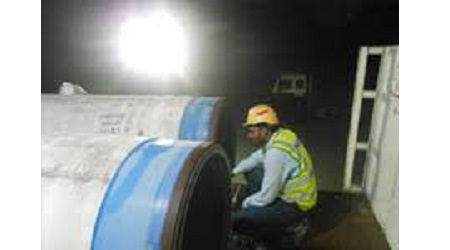
LMATS is NATA accredited in several test methods in different engineering fields.
LMATS is accredited in accordance with ISO 17025 in some of the coating related tests. LMATS Engineers performing various types of test on coatings and NACE certified coating inspectors are also authorised under ISO 17025 Accreditation system to perform other types of engineering tests. This additional experience and qualification of LMATS coating inspectors and Engineers assist LMATS clients the added value to their product verification or certification.
LMATS is the place For Coating Inspection, Pre Coating Inspection, Forensic Coating Failure Investigation, Coating Failure Analysis Services, Expert Witness Services