Morgan Ward NDT is one of the world’s leading providers of non-destructive testing, inspection and advisory services to the aerospace, petrochemical, defence and general engineering industries.
Our highly skilled team of specialist technicians are based at various locations across the UK but offer on-site inspection throughout the UK and the rest of the world.
We have extensive experience supplying personnel and consultancy services for global assignments and international projects.
Morgan Ward have been leaders in non-destructive testing for almost fifty years and continue to offer top-quality inspection services to a vast range of industries, both in the UK and abroad.
The company and its individual technicians carry an extensive range of national, international and customer approvals and certifications.
We deliver an exceptional and efficient, fully certified NDT service to all branches of global industry.
We are NADCAP approved NDT company with 3 facilities in the UK, Prestwick, Manchester and Stansted, covering all the traditional NDT methods together with the more advanced Phased Array UT, Thermography. We also hold CAA and FAA approval for aircraft inspections together with many prime and carrier approvals.

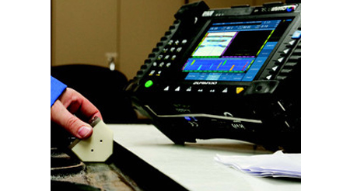
Phased Array Ultrasonics (PAUT) is an advanced non-destructive method of ultrasonic testing that is used to locate flaws in materials across the industrial, defence, marine and aerospace sectors.
Phased array is widely used across industrial sectors such as oil and gas, nuclear and large-scale construction. PAUT is generally considered an advanced NDT method, commonly used to detect component failures but also used in the inspection of welds, corrosion mapping, and thickness measurements over larger areas.
In the aerospace industry, phased array is employed in the inspection of engine blades, scribe line inspections and in mapping areas of aircraft skins for remaining thicknesses and corrosion levels.
Morgan Ward’s technicians are qualified to carry out and advise on phased array techniques and custom inspections and can conduct tests on-site globally and at any one of our UK laboratories.
All our inspectors are level II or level III certified to EN4179/NAS410 or PCN, where relevant.

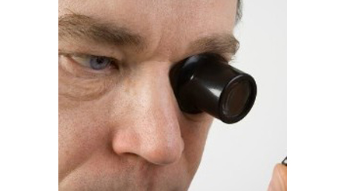
Visual inspection is a primary method of non-destructive testing that provides a means of detecting and examining a variety of flaws on a range of components either in-service or at various stages during manufacture.
Visual inspection is the most widely used method for detection and initial examination of surface discontinuities and their relationship to structural failure.
Visual testing is an excellent initial methodology to carry out prior to inspecting any component with a more time-intensive procedure such as magnetic particle inspection or dye penetrant testing.
All Morgan Ward technicians are regularly eye-tested and routinely use various magnification aids under powerful white light to discern and record flaws in materials across all industries and sectors.

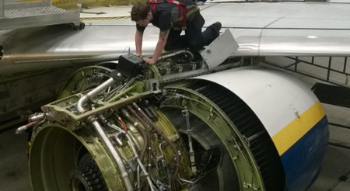
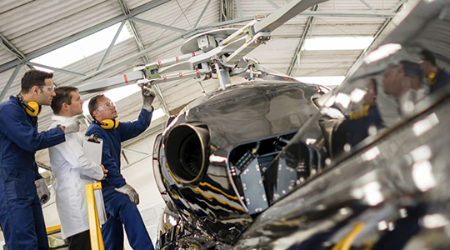
Morgan Ward have been inspecting aircraft for almost fifty years. During that time, we’ve worked on light aircraft, business and executive jets, helicopters, military fighter jets, mainstream airlines and multinational carriers.Over more than half a century, we have had the privilege of working with various aircraft operators around the world. We have long-standing partnerships with maintenance and overhaul organisations (MROs) as well as working closely with a diverse range of approved suppliers to the international aircraft industry.
We work alongside BAE Systems to provide NDT services for the Royal Air Force Nimrod refurbishment programme, as well as their BAE Hawk and EADS Typhoon projects.
Aircraft on Ground
Morgan Ward have an excellent record of quick response NDT support in Aircraft On Ground (AOG) situations. We have always known that sudden circumstances require rapid response times. That’s why all of our offices can be contacted 24 hours a day, 7 days a week.
We ensure that our technicians can be on-site and ready to undertake all inspections as quickly as possible, at all times. Our AOG inspection service is available internationally, at immediate notice.
Any and all of our NDT services are available to aircraft manufacturers and operators on a worldwide basis. Smaller sub-assemblies and transportable components can be submitted for test at any of our laboratories in Manchester, Prestwick and Stansted.
Approvals
Morgan Ward currently hold approvals for NDT inspections on all aircraft types as well as materials, composite/metallic components and structures under the approvals listed below:
Methods
Morgan Ward offer all the primary NDT methods and we are especially proud to provide expertise with any of the following advanced methods:

Morgan Ward employs all non-destructive testing methods to inspect welded structures, sub-assemblies and machined components used in the nuclear, petrochemical, defence and general engineering sectors.
We offer approved inspection services within our purpose-built NDT laboratories across the UK and many of our services can also be offered on site when products are too large or difficult to transport.
Our engineering NDT services include, but are not limited to:
Fully detailed and comprehensive reports are issued with each item/batch tested.
Any of our NDT services are available to manufacturers and operators on a world-wide basis. Smaller sub-assemblies and transportable components can be submitted for test at any of our laboratories in Manchester, Prestwick and Stansted.
All our inspectors are level II or level III certified to EN4179/NAS410, PCN or ASNT where relevant.

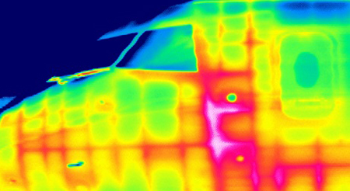
Thermography is a non-contact, non-destructive testing method used in the aerospace, defence and general engineering industries that utilises infrared imaging to detect flaws in a variety of structures.
Thermographic inspection can be used over a large area, without the need for direct contact with the component, and can detect a range of defects, including:
Voids, Moisture Ingress, Delaminations, Corrosion, Disbonds, Porosity, Crack Propagation, Impact Damage, Diffusivity and Systematic Wall Thinning.
Our technicians can advise on thermographic procedures and techniques for the inspection of various materials and can carry out testing on site globally or in one of our UK laboratories.
More specifically, thermography inspections (TT) are used in accordance with Airbus rudder task NTM 55-40-09 ‘inspection of the sandwich structure of the elevator panels using thermographic technique for trapped water inside the honeycomb core cells’ & Elevator task NTM 55-20-07 ‘Inspection of the bonding layers between rudder side panel honeycomb structure and external skins of the rudder side panels’.
Morgan Ward NDT can offer a quick and cost effective service to the airline industry on a worldwide basis. We have approved engineers and thermography inspection kits ready to inspect any customer specific aircraft applications.
All our inspectors are level II or level III certified to EN4179/NAS410 or ASNT, where relevant.

Pulse Thermography is a non-destructive technique used to find defects in aircraft and aerospace components. Pulse thermography allows materials to be inspected very quickly for near-surface defects and bonding weaknesses.
In pulse thermography the material to be inspected is heated up equally using a very short heat pulse. Defects, bonding faults and corrosion can be observed using a thermographic camera on the surface.
More specifically, pulse thermography inspections are used in accordance with Airbus AD 2014-0033 & AD 2013-0302. ‘Inspection of the rudder side shell sandwich repair inspection’.
Morgan Ward have now purchased a pulsed thermography inspection kit, specifically for the rudder side shell sandwich repair inspection, AD 2014-0033 & AD 2013-0302. This adds to our current scope of thermography inspections including the Elevators (55-20-07), Rudder (55-40-08) and ELCH inspections (55-40-09).
Morgan Ward NDT can offer a quick and cost effective service to the airline industry on a worldwide basis. We have approved engineers and pulse thermography kit ready to inspect any Airbus A318/319/320/321/330 or 340 aircraft.
All our inspectors are level II or level III certified to EN4179/NAS410 or ASNT, where relevant.