back to companies
 Service
 United Kingdom
MoviTHERM - Advanced Thermography Solutions
We provide Infrared Non-Destructive Test Systems ('IR-NDT') and Solutions for Flash/Pulse, Transient, Lockin and Vibro-Thermography.
ServiceUnited Kingdom Loading…ServiceUnited Kingdom

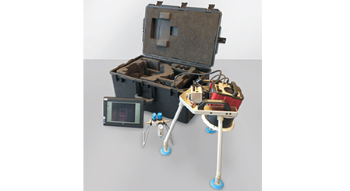
The Portable Solution C-CheckIR for Non-Destructive Testing with Active Thermography
Portable Thermography System for Non-Destructive Testing
The portable C-CheckIR system enables you to inspect a wide range of materials with active thermography. The system achieves precise and reliable measurements and is ideal for inspecting composite materials like glass- or carbon-fiber reinforced plastics (GRP/CFRP). C-CheckIR is easy to handle and requires minimal training. The entire inspection head is mounted on a lightweight support frame equipped with vacuum suction feet. This design permits positioning of the system over a wide variety of surfaces.
Active Thermography
The system includes a heat source to provide thermal excitation to the inspected material. The flow of thermal energy through the material has a direct influence on the material’s surface temperature topology. An infrared camera records the material’s surface temperature over a specified period of time. The chronological temperature data is processed, analyzed, and displayed as an image. The resulting image provides information about the internal structure of the material and possible defects present within it.
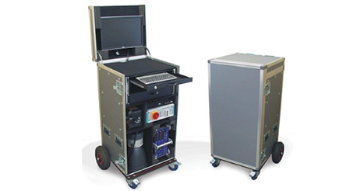
Turn-key NDT for Composite Inspection Using Advanced Thermography
High Speed / Flexible:
All kinds of defects in parts from different composite materials can be reliably detected within short times.
Detects All Key Defects on a Variety of Materials:
Defects like delaminations, cracks, impact damages and water inclusions are detected and displayed with excellent contrast. Detects thermal stress and “far side” defects.
Suitable for all kinds of composites like CRP (Carbonfiber Reinforced Plastics), GRP (Glassfiber Reinforced Plastics), Honeycombs, CFRC (Carbonfiber Reinforced Ceramics) GLARE (Glassfiber Reinforced Aluminum Laminate):
Easy and reliable measurement setup:
Large area measurements (up to 10 sq. ft.).
Insensitive to thermal reflections and variations in emissivity.
Accommodates a Wide Range of Measurements Methods:
Depending on your application needs, Composite-Check can utilize a number of NDT methods:
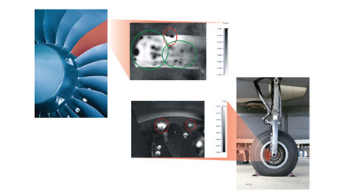
Advanced NDT Detection for Metallic, Ceramic and Composite Materials
High Speed / Flexible:
Variable system design, from mobile systems for laboratory applications up to robot guided in-line systems with high speed measuring and fully automated data processing.
Easy and fast changeover for the measurement of different parts and materials.
Measures All Key Defects on a Variety of Material:
Cracks are displayed with excellent contrast.
Suitable for all kinds of metallics, ceramics and composites.
LockIn Vibro-Thermography NDT Solution:
During the measurement of the inspected part heat is generated only at positions with defects. The heating is adjustable by the ultrasound power applied to the part.
Even temperature-sensitive materials can be inspected.
Only 10% of the ultrasound energy is necessary compared to conventional vibro-thermography systems, thus preventing further damage to the cracked area.
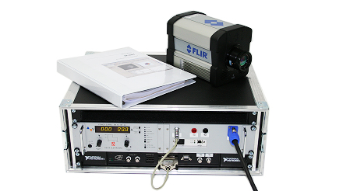
Turn-Key Solution for IR solar cell testing methods.
Shunt Detection – Simple and Accurate
Solar-Check addresses the critical need in the solar industry to efficiently and accurately detect shunts in thick-film and thin-film photovoltaic cells and panels.
Supports Optical and Electrical Excitation
Solar-Check is suitable for shunt detection in a production environment as well as in a research and development setting. Optical excitation allows for a true – non-contact inspection, enabling automated part handling.
Dark spots indicate shunted areas in cell. Lock-in excitation frequency: 50Hz.
Same cell as on the left, this time with 200Hz excitation.
Accurate Measurements – Lock-in Eliminates Reflections
The lock-in technique used in the Solar-Check solution significantly enhances the appearance of the defects in the resulting thermal image. Reflections and the adverse effects of thermal diffusion are eliminated, thereby pinpointing defect locations.
IR image of 60x60mm silicon solar cell showing shunt defects (orange areas) under steady state reverse bias conditions. Also visible is the refection caused by the lens of the thermal camera in addition to significant thermal diffusion around the shunted areas.
Same cell as image above. Here the “Lock-in” technique has been applied. All reflections and effects of thermal diffusion have been eliminated, hence allowing easy spotting of shunts.
Increased Sensitivity
Solar-Check’s built in lock-in measurement technique only responds to thermal responses from the solar cell only at the exact excitation frequency; thereby dramatically improving the overall sensitivity of the system. Typical thermal camera sensitivity is around 25 mK, MoviTHERM’s Solar-Check solution increases the system’s sensitivity to the µK range!
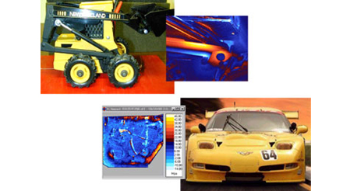
Modern Thermoelastic Stress Analysis (TSA ) shows: