SWA have extensive experience operating in offshore oil and gas, mining, refinery, commercial and Industrial providing Non-destructive testing, lifting equipment inspections, drops surveys, piping surveys and rope access.
SWA are a Perth-based Inspection company with the goal of providing quality service at the highest standard for a reasonable price.
At SWA they value their clients just as they do their employees and work in synergy to produce the best results and a long-term partnership.
SWA have current projects operating in the WA and NT Offshore industries, WA Pilbara and Perth local mining and fabrication workshops
SWA aims for the highest standard in everything they do and as such, they abide by LEEA for all lifting equipment inspections, utilise IRATA rope access technicians for all working at height and rope access tasks and are currently in the process of obtaining NATA 17020 and 17025 accreditation for Inspections and Testing.

Dye Penetrant Inspection (DPI/PT) is widely used to detect surface-breaking flaws.
This non-destructive testing technique, also known as liquid penetrant inspection (LPI), is a cost-effective method used to locate surface-breaking flaws such as cracks, porosity, laps, seams and other surface discontinuities.
Dye penetrant inspection can be applied to both ferrous and non-ferrous materials and all non-porous materials (metals, plastics or ceramics). This method does not detect subsurface discontinuities like MPI.
It is commonly used to detect defects in weldments, castings and forgings. This method is also useful for testing on-site as it is portable, and when applying certain techniques such as visible color contrast there is no need for additional resources such as electricity or water. This makes it highly convenient and effective for inspecting surface discontinuities.
Dye Penetration Testing in Perth, Regional WA and Offshore.
We provide a range of dye penetration testing and inspection services to fabrication workshops, commercial, industrial, mining/ processing plants, refineries, and marine and offshore facilities.

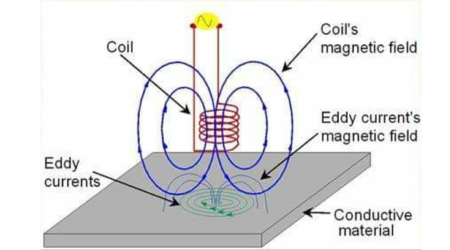
Eddy Current Inspections use a coil of conductive wire that is excited with an alternating electrical current. This wire coil produces an alternating magnetic field around itself.
The magnetic field oscillates at the same frequency as the current running through the coil. When the coil approaches a conductive material, currents opposite to the ones in the coil are induced in the material causing an impedance on the digital display.
Eddy Current Inspections are most common in the oil and gas industry and with inspections of in-service equipment due to its ability to inspect coated materials without the need for paint removal and re-application. This results in a much more time-efficient manner and reduction of additional hazards associated with paint removal and application of paint.
Variations in the electrical conductivity and magnetic permeability of the test object, and the presence of defects cause a change in eddy current and a corresponding change in phase and amplitude that can be detected by measuring the impedance changes in the coil, which is a telltale sign of the presence of defects.
This is the basis of the standard used in modern Eddy Current kits.
Eddy Current Testing in Perth, WA & NT
ECI has a very wide range of applications. Since ECI is electrical in nature, it is limited to a conductive material. There are also physical limits to generating eddy currents and depth of penetration.
At present, we offer a variety of inspection and testing services to industries in Perth, WA, NT and offshore.

SWA Inspection Services has a team of highly trained LEEA inspectors, experienced in Lifting Equipment Inspections to the Australian Standards and LOLAR. Upon completion of inspections, SWA is able to provide registers of findings, results and test certificates to certify the equipment to the relevant standards. All results are released to clients in our cloud-based management system to ensure full traceability and ease of access to our clients.
3rd party lifting equipment inspections give everyone the peace of mind that inspections have been completed in accordance with the correct standard and by a “Competent” inspector.
Lifting Equipment Inspection Perth
Lifting Inspection Services
Our team of lifting equipment inspectors are all LEEA trained and have extensive experience in lifting, rigging and safety. We are constantly training, learning and developing our business to deliver safer and more efficient inspection solutions for our clients.
We adhere to all Australian standards to stay compliant and ensure a safe workplace for all of our clients. With ongoing training and internal upskilling, we are confident we can assist in all ongoing lifting equipment inspections in Perth, WA, NT and offshore projects.

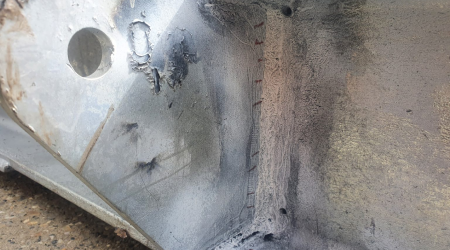
Magnetic particle Inspection (MPI) is a non-destructive testing (NDT) process for detecting surface and shallow subsurface discontinuities in ferromagnetic materials such as nickel, cobalt and iron. The process puts a magnetic field into the item to be tested.
The piece can be magnetized by direct or indirect magnetization. Direct magnetization occurs when the electric current is passed through the test object and a magnetic field is formed in the material.
Indirect magnetization occurs when no electric current is passed through the test object, but a magnetic field is applied from an outside source.
The magnetic lines of force are perpendicular to the direction of the electric current, which may be either alternating current (AC) or some form of direct current (DC) (rectified AC).
The presence of a surface or subsurface discontinuity in the material allows magnetic flux leakage since air cannot support as much magnetic field per unit volume as metals.
To identify a leak, ferrous particles, either dry or in a wet suspension, are applied to a part. These are attracted to an area of flux leakage and form what is known as an indication, which is evaluated to determine its nature, cause, and course of action, if any.
Magnetic Particle Testing in Perth, WA & NT
We are working on several projects involving magnetic particle testing and inspection for various industries in Perth, WA, NT, and offshore.

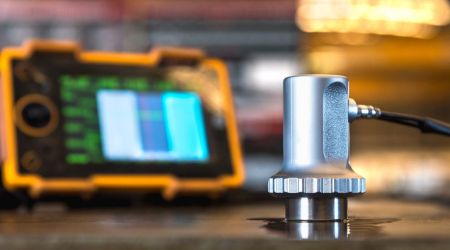
Ultrasonic testing is one of the most common methods for the non-destructive inspection of materials. Ultrasonic testing uses vibrations, in the form of ultrasonic waves, to search for internal discontinuities.
Ultrasonic Weld Testing
Weld testing is one of the main applications of ultrasonic testing (UWT). Using ultrasonic flaw detectors, NDT technicians find and characterize discontinuities within the weld that may lead to material or component failure.
Ultrasonic weld testing (UWT) is part of weld quality control and is crucial for ensuring safety in a wide range of industries due to its suitability for many different materials.
UT Testing is ideally used for the inspection of dense, crystalline structures such as metals. Ceramics, plastics, composites and concrete can also be successfully inspected but with reduced resolution, since the attenuation in these materials is higher.
Ultrasonic Testing can be a crucial tool to mitigate against cracking in pressurised vessels, rail tracks, mechanical components, aerospace and piping.
Ultrasonic Testing in Perth, WA & NT
Ultrasonic flaw testing technology has been successfully employed in the medical sector for many decades and is increasingly the preferred option for both routine diagnostic imaging and medical research because of the absence of ionising radiation.
At present, we are working on a range of projects for various industries in Perth, WA, NT and offshore. Our comprehensive ultrasonic testing and inspection services are available to help these businesses succeed.