TECNITEST INGENIEROS is a Non-Destructive Testing (NDT) engineering company, with more than twenty-five years of experience, focused on the development and deployment of NDT systems and Innovative ideas and products in the industry 4.0. In addition, its activity is complemented by the distribution of a complete range of NDT equipment and accessories, training, NDT Level III services (consulting, procedures writing and revisions, audit preparation, training, etc.) and technical advice when required.
TECNISTES´s activity addresses all industrial sectors and comprises all NDT methods, paying special attention to the use of advanced technologies and innovation. The highly skilled personnel of the company have sufficient capacity to design and develop their systems, fully assuming the mechanics, electronics, and application software, allowing TECNITEST to offer a full and inclusive service from application query to execution and beyond. In this way, in recent years has included in its developments advanced robotics, automation and artificial intelligence techniques, among others.
TECNITEST has been awarded with the Innovative SME seal by the Spanish Ministry of Economy and Competitiveness. This seal is a recognition of companies that have demonstrated their character innovative spirit and ability over the years. Thus, TECNISTEST has been participating in different national and European Research and Development projects, specifically related to Non-Destructive testing applications and techniques.


In the manufacturing processes of the aeronautical sector, the use of composite materials is a frequent practice allowing great advances which is rapidly spreading to other fields.
The high-quality standards required for this type of material require 100% quality control of the structural elements before these parts are assembled and subsequently used.
For conventional ultrasonic testing, single-element probes are used to generate an ultrasonic signal into the material to inspect it. However, when inspections are done on composite materials, phased array probes (PA) are now being used to detect component failures and thereby determine their quality more rapidly.
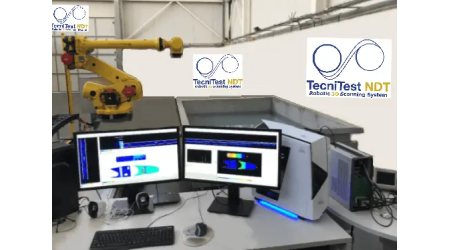
Tecnitest Robotic system has robotized trajectory tracking, applying Pulse-Echo, and Double Transmission techniques with Phased Array technology, as well as TT transmission, with water coupling, so that it is possible to inspect one hundred per cent of monolithic structures of solid laminates and sandwich structures.

The Boretest is an ultrasonic NDT hollow train axle inspection unit, in the final process of certification by the Deutsche Bahn, designed and manufactured by Tecnitest Ingenieros SL, a leading European NDT Engineering Company from Madrid, Spain.
We offer an easy and reliable solution for in-service train axle inspection.

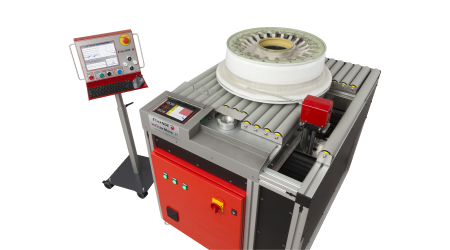
The VEESCAN H is ETher’s first Wheel Inspection System and offers maximum flexibility.
The VEESCAN has a proven mechanical design and an established record of breakdown-free operation for 365 days or more. Appealing to many companies in the Aerospace industry, the VEESCAN is ideal in all aircraft wheel-testing environments.
The VEESCAN can be configured with a wide choice of probes and allows any wheel testing facility the flexibility to select the system most compatible with their workload. Teamed with a full choice of operation modes,
The VEESCAN maximises the probability of detection.
The VEESCAN is offered with the ETher NDE guarantee of complete client satisfaction and excellent technical support.

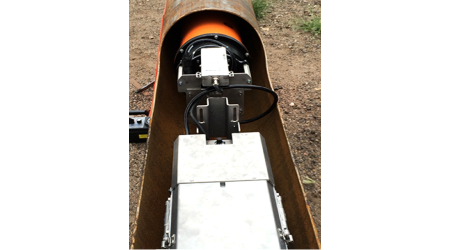
Tecnitest system ‘C’ crawlers are X-ray or Gamma ray crawlers for the inspection of welded joints in pipes of internal diameter 6” to 48” (or 72” with suitable adapters).
The systems are battery-operated and travel at about 12m per minute. The system uses an electronic locating device or a small gamma source for location and positioning purposes, giving an accuracy of movement of 5 mm, ideal for positioning the x-ray tube or gamma source to inspect a welded joint.
The wheel axles on the crawlers are variable and extendable to ensure the centring of the unit within the pipe.
The sensor controller, either electronic or gamma (Cs 137), stops the crawler at a defined position and after a short period, commences the inspection. Reprogramming of operating routines to suit different working conditions or requirements can be easily upgraded, via the internet, by Tecnitest personnel.
The two types of crawlers are the C0618, for pipes 6” to 18” and the C1048 for pipes 10” to 48” or up to 72” with suitable adapters.

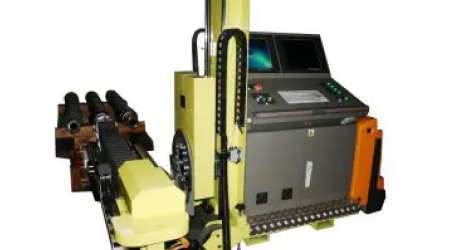
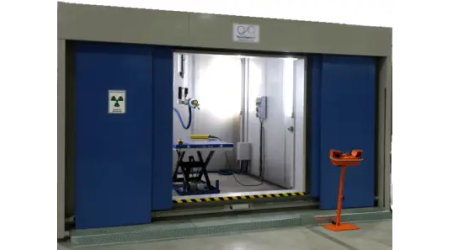
The radiographic cabin equipment is designed to perform radiography on pieces placed on a table that can be rotated inside a shielded enclosure.
It consists of a shielded cabin that allows safe operation of X-ray equipment up to 320kV.
Inside the cabin are motors which allow the displacement of the X-ray tube in the Y direction and the Z direction, the X direction is controlled by the arm that contains the rotating table.
The cabin has a motorized security door to allow access to the parts and prevent the operation of the X-ray equipment should the door be open.
The movement of the table and the x-ray head is controlled by motors and the position, X, Y, Z, and rotary position(W), is shown on a monitor in the control cabinet outside the cabin.
The control panel for the X-ray equipment is also contained in this cabinet. The X-ray head can also be rotated for angled shots.